
MORE FLAVOUR. MORE ESTER.
We never played it safe. Now we’re scaling the distillery, the brand and the ambition
Live - Open for investment Ester Spirits (Ascendant Bev. Vent. P/L)
Ester Spirits (Ascendant Bev. Vent. P/L) | Equity Crowdfunding
Min. reached. Now targeting $1 million
$506,216
Raised221
InvestorsOn-Market BookBuilds Pty Ltd (ABN 31 140 632 024) (“OnMarket”) operates under an Australian Financial Services Licence (AFSL 421 535) issued by the Australian Securities and Investments Commission.
Please consider the offer document and general risk warning before investing.
Retail investors are entitled to a 5 day cooling-off period.
Investments over $10,000 are restricted to Sophisticated investors - Apply here
Click here to learn more about Equity Crowdfunding
BACKYARD BEGINNINGS WITH GLOBAL RECOGNITION AND BIG AMBITION
Ester started in 2020 with $20,000, a 20-litre still in the backyard of a Newtown terrace and a fairly uncompromising idea about flavour.
We believed Australian spirits could stand alongside the world’s best not by playing it safe, but by making drinks with more flavour, more character and a point of view.
Six years later, we’ve won World’s Best Navy Gin, World’s Best Spiced Cane Spirit and World’s Highest-Scoring Liqueur.
Today, Ester makes award-winning spirits and cocktails from our Marrickville distillery, pours in some of Australia’s best bars and restaurants, and manufactures drinks for leading hospitality brands.
Revenue reached $1.57 million in FY26, growing more than 40% annually over the past three years.
We’ve built the brand. We’ve proved the product. Now it’s time to scale.
What to know more? Watch the Investor Q&A here.
BUILT TO SCALE
We’ve spent six years proving the product, building the brand and growing the business. This raise is about giving Ester the capacity, people and infrastructure to scale.
- Revenue up 43% in FY26, and growth has accelerated every year for four years.
- Three world-leading titles across gin, cane spirit and aperitif.
- 75% gross margin, with operating costs falling as a share of revenue.
- Contract manufacturing grew 10× in FY26, creating a fast-growing revenue stream alongside the Ester brand.
- A new Newtown home with ten times the capacity, including a 2,000L still house (up from 200L), unlocking significantly greater production, hospitality and events capacity.
- Investment in equipment and a national sales team will allow us to make more and sell more.
- James France has joined Ester as investor and partner, bringing decades of experience building and distributing premium spirits brands.
- Our ambition: build Ester into one of Australia’s most iconic (drinks) brands.
- A complete brand evolution with award-winning New Zealand studio Marx Design, creating an iconic, bespoke Ester bottle and distinctive new label system - sharpening our maximalist identity into something bolder, more luxurious and unmistakably Ester, with stronger shelf presence and recognition across our growing range.
SPIRITS THAT GO BEYOND THE BOTTLE
Ester is more than a spirits brand. We’ve built a diversified business across branded products, contract manufacturing and hospitality three revenue streams that strengthen each other.
Our spirits and cocktails are sold through bars, restaurants, bottle shops, online and direct from the distillery. Our fast-growing contract business develops and manufactures drinks for other leading brands, growing tenfold in FY26.
Hospitality gives Ester another revenue stream while putting customers directly inside the brand through our distillery bar, food, events and private functions.
Our new Newtown site allows us to scale all three: greater production, increased contract manufacturing, broader distribution and a significantly larger hospitality and events business. The new venue will bring together a full-scale distillery bar, food, weddings and private events, live music, pop-ups, markets and industry nights - creating more reasons to visit, stay longer and come back.
Alongside this growth, we’re evolving the Ester brand with Marx Design, creating an iconic bespoke bottle and new label system designed to sharpen our identity, strengthen shelf presence and support a growing product range.
More capacity. More customers. More ways to grow.
A $6+ BILLION MARKET. MOSTLY IMPORTED
Australians spend an estimated $6-7 billion on spirits each year, yet only around 10% of the spirits we buy and drink are Australian-made.
That leaves an enormous domestic market still dominated by imported brands despite Australian distillers now producing spirits capable of competing with the world’s best.
For Ester, the opportunity is twofold. Grow our share of a multi-billion-dollar spirits market, while building a destination hospitality business around the brand.
Our new Newtown site gives us the production capacity to reach more retailers, bars and restaurants nationally, alongside a significantly larger distillery door, bar and events business.
And we’re approaching that opportunity with momentum: Ester has grown more than 40% annually for the past three years.
A huge existing market. A tiny Australian share. Plenty of room to change that.
FIVE YEARS OF GROWTH, THREE WORLD TITLES
Revenue (unaudited management accounts, year to 30 June):

- Revenue grew 43% in FY26, with five of seven revenue streams growing.
- Contract distilling grew from $29,000 to $293,000 in one year more than 10×.
- Over 81,000 equivalent bottles produced. Last 5 years.
- Partnerships extend beyond the drinks industry, with Ester sponsoring the Sydney Festival, Sydney Writers’ Festival and Good Food Guide Awards.
- World’s Best Navy Strength Gin 2021.
- World’s Best Spiced Cane Spirit 2024.
- World’s Highest-Scoring Liqueur, IWSC 2025.
- Best in show - Australian Gin Awards 2025 - Old Tom Gin
- Best in Show - Australia Gin Awards 2020 - Strong Gin
- 2026: released our first whisky after nine years in cask,
- Welcomed James France as an investor and partner, and secured our new home at the former Young Henrys site in Newtown.
WE BACK OUR TASTE OVER THE MARKET. IT KEEPS WINNING
Ester has never grown by chasing what the market was already doing.
We didn’t launch another pink gin. We released a 57% Navy Strength Gin and it became the world’s best. We didn’t make another sweet aperitivo. We made ours bitter, complex and unapologetically grown-up and it became the world’s highest-scoring.
That instinct has become one of Ester’s greatest advantages: a clear point of view on what should exist next, and the production capability to make it ourselves.
But great liquid alone doesn’t build a great business. Around it, we’ve built a distinctive brand, direct relationships with customers, hospitality, wholesale distribution and a fast-growing manufacturing business.
The products are difficult to replicate. The brand is even harder.
Some of Australia’s best-known independent spirits brands have ultimately been acquired by global drinks companies. What they recognised is difficult to manufacture at corporate scale: an authentic brand, with a loyal audience and a genuine place in culture.
Ester remains independent. And this time, the people who drink it have the opportunity to own part of what comes next.
OWN A PIECE. GET THE GOOD STUFF
Being an Ester shareholder should come with benefits beyond owning shares. So we’ve put together a few things money usually can’t buy from lifetime discounts and first access to limited releases, to your name on the furniture and a session blending your own bottle with Felix.
Rewards are cumulative, so the further you go, the better it gets. And every shareholder gets access to our Winter Solstice and Welcome Summer parties two nights a year when the new distillery belongs to the people who backed it.
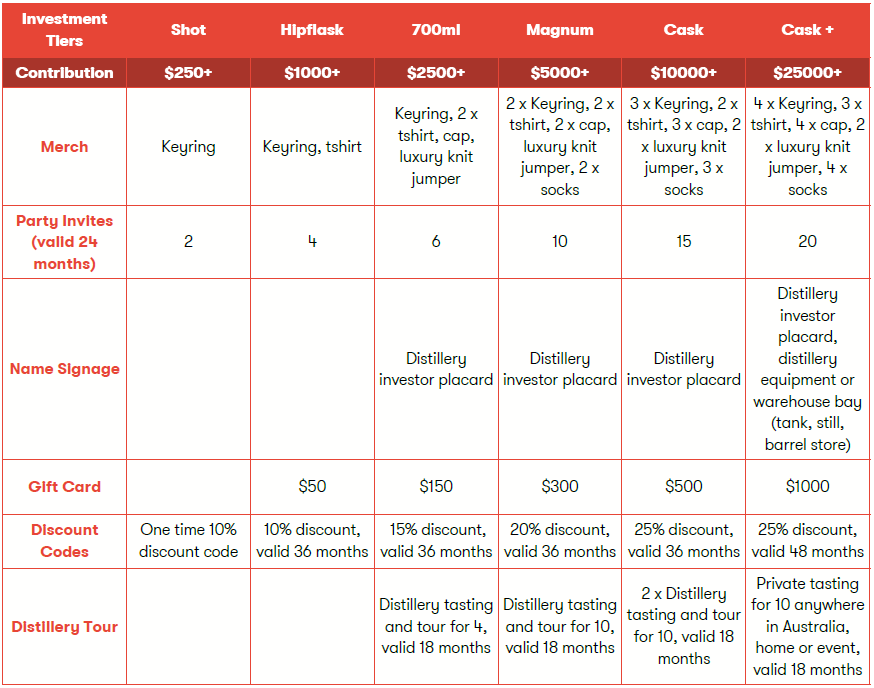
*A complete list of the Investor RewardT&Cs will be available in the offer document
THE PEOPLE BEHIND ESTER

Felix Clark
Co-Founder, Head Distiller & Director

Corinna Kovner
Co-Founder & Creative Director

Will Nicholson
Chief Revenue Officer & Director

James France
Investor & Strategic Advisor

Dave Northmore
Digital Growth Advisor

Peter Guitronich
Leadership, Culture and Strategy

Pip Jacobs
Marketing Advisor
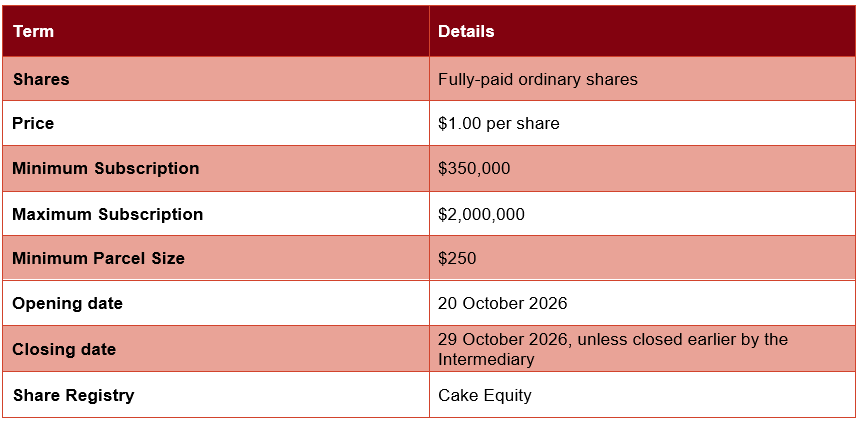
Terms of the Offer
Issued Capital
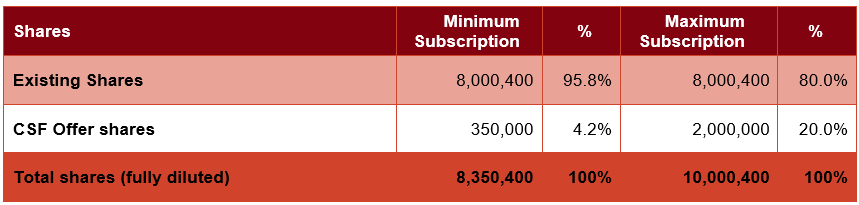
For more detailed information, please read the Capital Structure section of the offer document.
Use of Funds
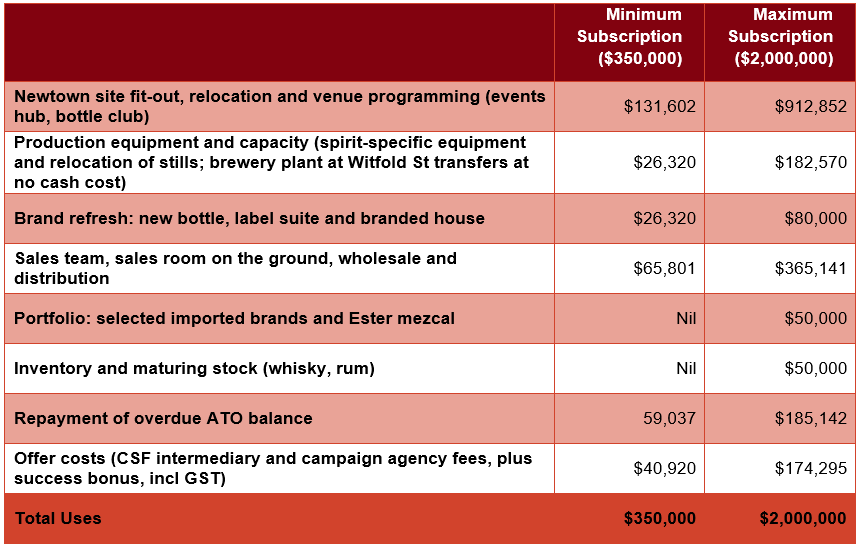
For more detailed information, please read the Use of Funds section of the offer document.
Company Risk
Ester makes award-winning spirits and cocktails from our Marrickville distillery, pours in some of Australia’s best bars and restaurants, and manufactures drinks for leading hospitality brands. As with any growth business, an investment in the Company should be seen as high-risk and speculative. A description of the main risks that may impact their business are listed in the offer document. Investors should read this section carefully before deciding to apply for shares under the Offer. There are also other, more general, risks associated with the Company (for example, holding company structure, trading losses and going concern, relocation and venue, excise and regulation, tax, customer concentration, key person, competition, supply chain and production, debt and cash flow, contract distilling and remission eligibility, Marrickville exit and asset write-down, lease and premises, reliance on events and hospitality demand, alcohol regulation and responsible marketing, or the inability to sell their shares). See the Risk section in the Offer Document for further information.
The Offer is subject to a Maximum Subscription amount of $2,000,000. If the Maximum Subscription is reached, the Offer will close early. Applications will be treated on a time priority basis and may be subject to scale back, so please fund your application as soon as possible.
RISK WARNING: Crowd-sourced funding is risky. Issuers using this facility include new or rapidly growing ventures. Investment in these types of ventures is speculative and carries high risks. You may lose your entire investment, and you should be in a position to bear this risk without undue hardship. Even if the company is successful, the value of your investment and any return on the investment could be reduced if the company issues more shares. Your investment is unlikely to be liquid. This means you are unlikely to be able to sell your shares quickly or at all if you need the money or decide that this investment is not right for you.
Even though you have remedies for misleading statements in the replacement offer document or misconduct by the company, you may have difficulty recovering your money. There are rules for handling your money. However, if your money is handled inappropriately or the person operating this platform becomes insolvent, you may have difficulty recovering your money. Ask questions, read all information given carefully, and seek independent financial advice before committing yourself to any investment.
5 DAY COOLING OFF PERIOD: There is a 5 business day cooling off period for retail investors. During this period, you may withdraw your application and receive a full refund into your nominated refund account. Please note: After the 5 day cooling off period has expired, you will be unable to withdraw your application. More information here.
ONMARKET FEES: Upon successful completion of the Offer, a maximum fee of 6.5% of the funds raised will be paid to OnMarket by the Company.
ONMARKET INTERESTS: OnMarket and its associates may be participating in this offer.
ONMARKET INTERESTS AND AMOUNTS SUBJECT TO COOLING OFF: The funding bar displayed under each crowd funding offer may include applications where payments are yet to be made and amounts that are subject to the cooling off period.
Section 734(6) disclosure: The issuer of the securities is Ascendant Beverage Ventures Pty Ltd t/a Ester Spirits ACN 688 762 156. The securities to be issued are fully-paid ordinary shares. The disclosure document for the offer can be obtained by clicking on the link above. The offers of the securities are made in, or accompanied by, a copy of the disclosure document. Investors should consider the disclosure document in deciding whether to acquire the securities. Anyone who wants to acquire the securities will need to complete the application form that will be in or will accompany the disclosure document (which can be done via the electronic application form which will become available by clicking the bid button above)
Question time
We'd love to answer your questions, we'll have one of the OnMarket team or the company representative of the offer get back to you asap. So ask away ...
1. **Valuation:** What milestones or changes justify the increase from approximately 31 cents per share for the recent investor to $1 for this offer?
Mandy K (OnMarket member) on 20/10/20262. **Current finances:** What are the current cash balance, outstanding debts and monthly cash burn, following the $500,000 investment?
3. **Funding and break-even:** What minimum raise is needed to complete the move and reach cash-flow break-even? Can you share a monthly forecast showing the impact of rent commencing in February 2027?
4. **Debt arrangements:** Is the ATO payment plan formally agreed, and what repayments are required? Will the $140,696 of related-party payables be formally deferred or subordinated?
5. **Lease security:** Does the Wilford Street lease allow early termination for demolition or redevelopment? How is Esters fit-out investment protected?
6. **Committed revenue:** How much forecast sublease and contract-production revenue is supported by signed agreements, and when will those payments commence?
7. **Exit protections:** Why does clause 8.8 allow a drag notice that breaches the shareholder agreement to remain effective against CSF investors? Could small investors be forced to sell while existing agreement parties retain their shares?
8. **Transfers between existing shareholders:** Given the tag-along exemption in clause 9.4, could control change between existing agreement parties without CSF investors receiving an equivalent offer?
9. **Reporting and dilution:** Will CSF investors receive quarterly financial and cash-flow updates, and an opportunity to participate in future raises to maintain their ownership percentage?
10. **Document correction:** Will the shareholder agreement be formally corrected to resolve its references to Ester Distilling where other sections identify Ascendant Beverage Ventures?
Thank you for the questions, and apologies; we may be repeating a lot of what the offer documents already say. The Offer Document does not contain forecasts or projections given the requirements of the offer, but we'll try and be as concise as possible.
Will N (Ester Spirits (Ascendant Bev. Vent. P/L) representative) replied to Mandy K on 20/10/20261. Valuation: what milestones or changes justify the increase from about 31 cents a share for the recent investor to $1.00 for this Offer?
Two things explain the difference, and the Offer Document covers both in Sections 2.6.1.1 and 2.6.6.1. First, timing. The Furman Group terms were agreed before the Wilford Street lease was secured, before the production plant and equipment at that site transferred to the group at no cash cost, before the FY26 result (revenue up 43%, contract production ten times the prior year) and before the first whisky range was released. Each of those has happened since, and the directors' reasons for the higher price are listed in Section 2.6.6.1. Second, what Furman Group brought. James France is one of Australia's most experienced premium spirits operators, and his investment came with an ongoing strategic role: market and sales advice, advocacy for the brand in the trade, and experience of how Australian spirits brands are built and sold (Section 2.8.4). An early investor who brings that to a company of Ester's size is priced differently from a public offer of ordinary shares.
2. Current finances: cash balance, outstanding debts and monthly cash burn after the $500,000 investment.
The Offer Document reports the position at 30 June 2026 (Section 2.10): cash of $63,183, borrowings and other financial liabilities of $196,817 (Section 2.6.7), trade and other payables of $643,837 including $289,497 owed to the ATO, and a loss for the period of $239,476.
Since 30 June the Company has received the $500,000 Furman subscription, of which $250,000 was advanced to Ester Distilling in July (Section 2.10.5), and $147,753 of a shareholder loan was converted to equity. The Company does not publish monthly management figures or a cash burn rate outside the Offer Document. The trading losses and debt and cash flow risks are described in Section 2.9.
3. Funding and break-even: what minimum raise is needed to complete the move and reach break-even, and can you share a monthly forecast showing rent from February 2027?
The Offer Document does not contain a cash-flow forecast or a break-even date, and we are not able to provide one on this facility because a forecast in a CSF offer requires a documented reasonable basis and OnMarket's review. What the document says is this (Section 3.2): the Maximum Subscription is expected to meet the Company's short-term objectives over the next 12 months; if only the Minimum Subscription is raised, further funding will be needed over the next 12 to 18 months, which may include a further CSF offer, and in the meantime the fit-out will be phased, production and wholesale prioritised, part of the Wilford Street premises subleased, and the ATO balance managed through cash flow and a payment arrangement. The rent of $611,200 a year from February 2027 and its scale against FY26 revenue are set out in Section 2.9 (Relocation and venue risk).
4. Debt arrangements: is the ATO payment plan formally agreed and what repayments are required? Will the $140,696 of related-party payables be deferred or subordinated?
ATO: Section 3.2 commits $59,037 at the Minimum Subscription, or $185,142 at the Maximum, of the proceeds to the overdue ATO balance. The remainder is to be paid from FY27 trading cash flow under a payment arrangement to be agreed with the ATO, assisted by the Alcohol Manufacturer Remission. Related-party payables: the $137,196 owed to Felix Clark Pty Ltd and $3,500 owed to Felix Clark are unsecured, interest-free and repayable on demand (Section 2.6.7).
5. Lease security: does the Wilford Street lease allow early termination for demolition or redevelopment, and how is the fit-out investment protected?
The lease is for five years from 14 February 2027 with a five-year option to February 2037, and the Company intends to exercise the option. The lease discloses that the land is a development site for the lessor. During the initial five-year term, the lessor may not terminate early for the development unless it provides relocation assistance or reasonable compensation to Ester (Special Condition 31). During the option term, the lessor may terminate on six months' notice. The Relocation and Lease risks in Section 2.9 should be read with this.
6. Committed revenue: how much forecast sublease and contract-production revenue is supported by signed agreements, and when do payments commence?
The Offer Document does not forecast sublease or contract revenue. It describes the intention to sublease part of Wilford Street to contract distilling clients and other tenants (Sections 2.5.8 and 3.2) and reports FY26 contract distilling revenue of $292,523 (Section 2.5.5).
7. Exit protections: why does clause 8.8 allow a drag notice that breaches the shareholders' agreement to remain effective against CSF investors? Could small investors be forced to sell while agreement parties keep their shares?
Clause 8.8 does not create a different drag threshold for CSF investors. A drag can only be given if a buyer makes a bona fide arm's length offer for all shares, the directors approve it, and holders of at least 60% of the shares accept it (clause 8.1), and every dragged member must receive the same price per share, in the same form, on terms no less favourable (clause 8.4). Clause 8.8 deals only with the position between the parties to the shareholders' agreement: if one of them gives a drag notice in breach of that private agreement, the notice is ineffective against the other parties to it, because they have contractual remedies between themselves. CSF investors are not parties to that agreement (clause 25.2), so it cannot be used to give them less than the agreement parties receive on a sale. In practice, a drag that the agreement parties are not bound to accept could not deliver the whole company to a buyer, so it would not proceed.
8. Transfers between existing shareholders: given the tag-along exemption in clause 9.4, could control change between agreement parties without CSF investors receiving an equivalent offer?
Clause 9.4 excludes from the tag-along a transfer between parties to the shareholders' agreement made in compliance with that agreement, that is, a transfer among the four existing shareholders. Such a transfer would not trigger an offer to CSF investors. The tag-along does apply to any person outside that group who would come to hold more than 40% of the shares (clause 9.1), and on any sale of the whole company the drag-along's equal-terms protection applies to every member (clause 8.4). See Section 3.3.8 of the Offer Document.
9. Reporting and dilution: will CSF investors receive quarterly financial and cash-flow updates, and an opportunity to participate in future raises?
Reporting: yes. Section 4.3 commits to quarterly updates on progress, an annual shareholder event and shareholder-only communications, and once the Offer completes the Company must prepare and lodge annual financial reports with ASIC (Section 4.4.1). Dilution: the constitution gives no member a right of pre-emption on new share issues (clause 5.2), so there is no guaranteed right to participate in future raises, and Section 2.9 (Dilution and future funding) says so. The Company may consider a further CSF offer if only the Minimum Subscription is raised (Section 3.2), and CSF shareholders would be able to apply in any such offer on the same terms as everyone else.
10. Document correction: will the shareholders agreement be corrected where it refers to Ester Distilling and other sections identify Ascendant Beverage Ventures?
The shareholders' agreement binds only its parties and does not bind CSF shareholders (constitution clause 25.2), so any correction does not change any right of CSF investors. Ester Spirits is a 100% subsidiary of Ascendant Beverage Ventures.
1 Valuation: What specifically has changed since the $500k Furman investment to justify moving from an implied ~$2.49m valuation to $8m?
Adam R (OnMarket member) on 20/10/20262 ATO: What is the ATO balance today, how much remains overdue, and has a formal payment arrangement now been executed?
3 Newtown: What revenue/EBITDA does Newtown need to generate to cover its $611k annual base rent and total incremental operating cost?
4 Runway: Show us the monthly cash-flow forecast under $350k, $1m and $2m raise scenarios, including ATO payments and Newtown expenditure.
5 Next raise: At each scenario, when will you next require external capital and how much do you expect to need?
Hey Adam, The Offer Document does not contain forecasts or projections, so where a question asks for one, we have said so and pointed to the relevant section. I'd point to the financial document showing growing margin.
Will N (Ester Spirits (Ascendant Bev. Vent. P/L) representative) replied to Adam R on 20/10/2026In general: The history shows the business growing revenue faster than its costs. Between FY22 and FY26 revenue grew 2.7 times to $1,571,148 while cost of sales fell in absolute terms, lifting gross margin from 25% to 75%. Operating expenses, which were built up in FY23 and FY24 ahead of the revenue, peaked at 131% of revenue in FY24 and have fallen to 90% in FY26 as revenue doubled. From FY24 to FY26 each additional dollar of revenue carried about 15 cents of cost of sales and 48 cents of operating expenses, and the net loss more than halved from its FY24 peak to $239,476. These are historical figures from the financial statements in Section 2.10 and are not a forecast; the business is not yet profitable, and the risks in Section 2.9 apply.
In direct answer to your questions:
1. Valuation: what specifically has changed since the $500,000 Furman investment to justify moving from an implied $2.49 million valuation to $8 million?
Two things explain the difference, and the Offer Document covers both in Sections 2.6.1.1 and 2.6.6.1. First, timing. The Furman Group terms were agreed before the Wilford Street lease was secured, before the production plant and equipment at that site transferred to the group at no cash cost, before the FY26 result (revenue up 43%, contract production ten times the prior year) and before the first whisky range was released. Each of those has happened since, and the directors' reasons for the higher price are listed in Section 2.6.6.1. Second, what Furman Group brought. James France is one of Australia's most experienced premium spirits operators, and his investment came with an ongoing strategic role: market and sales advice, advocacy for the brand in the trade, and experience of how Australian spirits brands are built and sold (Section 2.8.4). An early investor who brings that to a company of Ester's size is priced differently from a public offer of ordinary shares. The Offer Document also says plainly that the business is loss-making, that its revenue base is smaller than the comparable offers, that the price is materially higher than the Furman round, and that investors should form their own view on whether these developments justify the difference.
2. ATO: what is the ATO balance today, how much remains overdue, and has a formal payment arrangement been executed?
The Offer Document reports the balance at 30 June 2026 as $289,497, most of it overdue, made up of GST, PAYG withholding and excise, including excise carried over from FY25 (Sections 2.6.7 and 2.9). The Company does not publish a running balance outside the Offer Document. The repayment plan is set out in Section 3.2: $59,037 at the Minimum Subscription or $185,142 at the Maximum will be paid from the Offer proceeds, with the remainder paid from FY27 trading cash flow under a payment arrangement with the ATO, assisted by the Alcohol Manufacturer Remission of up to $400,000 a year.
3. Newtown: what revenue or EBITDA does Newtown need to generate to cover its $611,000 annual rent and total incremental operating cost?
We cannot give a break-even figure on this facility, because it is a forecast and none is in the Offer Document. The facts the document gives are: rent of $611,200 a year plus GST from 14 February 2027 against FY26 revenue of $1,571,148 and FY26 Marrickville rent of $119,363 (Section 2.9); FY26 gross margin of 75% (Section 2.2); the production plant and equipment at the site transferring to the group at no cash cost (Section 2.5.8); and the intention to offset rent with sublease income from contract distilling clients and other tenants (Sections 2.5.8 and 3.2). Investors can form their own view of the gross profit the site must add from those figures.
4. Runway: can you show the monthly cash-flow forecast under $350,000, $1 million and $2 million raise scenarios, including ATO payments and Newtown expenditure?
The Offer Document does not contain a cash-flow forecast, and we are not able to provide one on this facility, because a forecast in a CSF offer requires a documented reasonable basis and OnMarket's review. What the document says is this (Section 3.2): the Maximum Subscription is expected to meet the Company's short-term objectives over the next 12 months; if only the Minimum Subscription is raised, further funding will be needed over the next 12 to 18 months, which may include a further CSF offer, and in the meantime the fit-out will be phased, production and wholesale prioritised, part of the Wilford Street premises subleased, and the ATO balance managed through cash flow and a payment arrangement. The use of funds at both the Minimum and the Maximum, including the ATO repayment line, is set out in the table in Section 3.2.
5. Next raise: at each scenario, when will you next require external capital and how much?
Section 3.2 says that at the Minimum Subscription the Company will require further funding within 12 to 18 months, which may be a further CSF offer, and that the Maximum Subscription is expected to meet short-term objectives over 12 months. No amount or date beyond that is stated, and the Dilution and future funding risk in Section 2.9 warns that further capital may be needed even at the Maximum. The constitution gives no member a right of pre-emption on new issues (clause 5.2), so participation in any future raise is not guaranteed, although CSF shareholders would be able to apply in any further CSF offer on the same terms as everyone else.
Will Nicholson
Director, Ascendant Beverage Ventures Pty Ltd
1. **Valuation:** What milestones or changes justify the increase from approximately 31 cents per share for the recent investor to $1 for this offer?
callum b (OnMarket member) on 20/10/20262. **Current finances:** What are the current cash balance, outstanding debts and monthly cash burn, following the $500,000 investment?
3. **Funding and break-even:** What minimum raise is needed to complete the move and reach cash-flow break-even? Can you share a monthly forecast showing the impact of rent commencing in February 2027?
4. **Debt arrangements:** Is the ATO payment plan formally agreed, and what repayments are required? Will the $140,696 of related-party payables be formally deferred or subordinated?
5. **Lease security:** Does the Wilford Street lease allow early termination for demolition or redevelopment? How is Esters fit-out investment protected?
6. **Committed revenue:** How much forecast sublease and contract-production revenue is supported by signed agreements, and when will those payments commence?
7. **Exit protections:** Why does clause 8.8 allow a drag notice that breaches the shareholder agreement to remain effective against CSF investors? Could small investors be forced to sell while existing agreement parties retain their shares?
8. **Transfers between existing shareholders:** Given the tag-along exemption in clause 9.4, could control change between existing agreement parties without CSF investors receiving an equivalent offer?
9. **Reporting and dilution:** Will CSF investors receive quarterly financial and cash-flow updates, and an opportunity to participate in future raises to maintain their ownership percentage?
10. **Document correction:** Will the shareholder agreement be formally corrected to resolve its references to Ester Distilling where other sections identify Ascendant Beverage Ventures?
Thank you for the questions, and apologies; we may be repeating a lot of what the offer documents already say. The Offer Document does not contain forecasts or projections given the requirements of the offer, but we'll try and be as concise as possible.
Will N (Ester Spirits (Ascendant Bev. Vent. P/L) representative) replied to callum b on 20/10/20261. Valuation: what milestones or changes justify the increase from about 31 cents a share for the recent investor to $1.00 for this Offer?
Two things explain the difference, and the Offer Document covers both in Sections 2.6.1.1 and 2.6.6.1. First, timing. The Furman Group terms were agreed before the Wilford Street lease was secured, before the production plant and equipment at that site transferred to the group at no cash cost, before the FY26 result (revenue up 43%, contract production ten times the prior year) and before the first whisky range was released. Each of those has happened since, and the directors' reasons for the higher price are listed in Section 2.6.6.1. Second, what Furman Group brought. James France is one of Australia's most experienced premium spirits operators, and his investment came with an ongoing strategic role: market and sales advice, advocacy for the brand in the trade, and experience of how Australian spirits brands are built and sold (Section 2.8.4). An early investor who brings that to a company of Ester's size is priced differently from a public offer of ordinary shares.
2. Current finances: cash balance, outstanding debts and monthly cash burn after the $500,000 investment.
The Offer Document reports the position at 30 June 2026 (Section 2.10): cash of $63,183, borrowings and other financial liabilities of $196,817 (Section 2.6.7), trade and other payables of $643,837 including $289,497 owed to the ATO, and a loss for the period of $239,476.
Since 30 June the Company has received the $500,000 Furman subscription, of which $250,000 was advanced to Ester Distilling in July (Section 2.10.5), and $147,753 of a shareholder loan was converted to equity. The Company does not publish monthly management figures or a cash burn rate outside the Offer Document. The trading losses and debt and cash flow risks are described in Section 2.9.
3. Funding and break-even: what minimum raise is needed to complete the move and reach break-even, and can you share a monthly forecast showing rent from February 2027?
The Offer Document does not contain a cash-flow forecast or a break-even date, and we are not able to provide one on this facility because a forecast in a CSF offer requires a documented reasonable basis and OnMarket's review. What the document says is this (Section 3.2): the Maximum Subscription is expected to meet the Company's short-term objectives over the next 12 months; if only the Minimum Subscription is raised, further funding will be needed over the next 12 to 18 months, which may include a further CSF offer, and in the meantime the fit-out will be phased, production and wholesale prioritised, part of the Wilford Street premises subleased, and the ATO balance managed through cash flow and a payment arrangement. The rent of $611,200 a year from February 2027 and its scale against FY26 revenue are set out in Section 2.9 (Relocation and venue risk).
4. Debt arrangements: is the ATO payment plan formally agreed and what repayments are required? Will the $140,696 of related-party payables be deferred or subordinated?
ATO: Section 3.2 commits $59,037 at the Minimum Subscription, or $185,142 at the Maximum, of the proceeds to the overdue ATO balance. The remainder is to be paid from FY27 trading cash flow under a payment arrangement to be agreed with the ATO, assisted by the Alcohol Manufacturer Remission. Related-party payables: the $137,196 owed to Felix Clark Pty Ltd and $3,500 owed to Felix Clark are unsecured, interest-free and repayable on demand (Section 2.6.7).
5. Lease security: does the Wilford Street lease allow early termination for demolition or redevelopment, and how is the fit-out investment protected?
The lease is for five years from 14 February 2027 with a five-year option to February 2037, and the Company intends to exercise the option. The lease discloses that the land is a development site for the lessor. During the initial five-year term, the lessor may not terminate early for the development unless it provides relocation assistance or reasonable compensation to Ester (Special Condition 31). During the option term, the lessor may terminate on six months' notice. The Relocation and Lease risks in Section 2.9 should be read with this.
6. Committed revenue: how much forecast sublease and contract-production revenue is supported by signed agreements, and when do payments commence?
The Offer Document does not forecast sublease or contract revenue. It describes the intention to sublease part of Wilford Street to contract distilling clients and other tenants (Sections 2.5.8 and 3.2) and reports FY26 contract distilling revenue of $292,523 (Section 2.5.5).
7. Exit protections: why does clause 8.8 allow a drag notice that breaches the shareholders' agreement to remain effective against CSF investors? Could small investors be forced to sell while agreement parties keep their shares?
Clause 8.8 does not create a different drag threshold for CSF investors. A drag can only be given if a buyer makes a bona fide arm's length offer for all shares, the directors approve it, and holders of at least 60% of the shares accept it (clause 8.1), and every dragged member must receive the same price per share, in the same form, on terms no less favourable (clause 8.4). Clause 8.8 deals only with the position between the parties to the shareholders' agreement: if one of them gives a drag notice in breach of that private agreement, the notice is ineffective against the other parties to it, because they have contractual remedies between themselves. CSF investors are not parties to that agreement (clause 25.2), so it cannot be used to give them less than the agreement parties receive on a sale. In practice, a drag that the agreement parties are not bound to accept could not deliver the whole company to a buyer, so it would not proceed.
8. Transfers between existing shareholders: given the tag-along exemption in clause 9.4, could control change between agreement parties without CSF investors receiving an equivalent offer?
Clause 9.4 excludes from the tag-along a transfer between parties to the shareholders' agreement made in compliance with that agreement, that is, a transfer among the four existing shareholders. Such a transfer would not trigger an offer to CSF investors. The tag-along does apply to any person outside that group who would come to hold more than 40% of the shares (clause 9.1), and on any sale of the whole company the drag-along's equal-terms protection applies to every member (clause 8.4). See Section 3.3.8 of the Offer Document.
9. Reporting and dilution: will CSF investors receive quarterly financial and cash-flow updates, and an opportunity to participate in future raises?
Reporting: yes. Section 4.3 commits to quarterly updates on progress, an annual shareholder event and shareholder-only communications, and once the Offer completes the Company must prepare and lodge annual financial reports with ASIC (Section 4.4.1). Dilution: the constitution gives no member a right of pre-emption on new share issues (clause 5.2), so there is no guaranteed right to participate in future raises, and Section 2.9 (Dilution and future funding) says so. The Company may consider a further CSF offer if only the Minimum Subscription is raised (Section 3.2), and CSF shareholders would be able to apply in any such offer on the same terms as everyone else.
10. Document correction: will the shareholders agreement be corrected where it refers to Ester Distilling and other sections identify Ascendant Beverage Ventures?
The shareholders' agreement binds only its parties and does not bind CSF shareholders (constitution clause 25.2), so any correction does not change any right of CSF investors. Ester Spirits is a 100% subsidiary of Ascendant Beverage Ventures.
1) Just to clarify, does the countdown mark the end of early access rather than the entire raise? When will the public offer close, and is there any difference in share price or allocation priority for early-access investors?
Mandy K (OnMarket member) on 21/10/20262) Felix mentioned other distillers queuing for production. How much future contract-distilling revenue is currently secured by signed agreements, over what period, and do customers pay deposits upfront?
3) Are any Wilford Street subleases signed? If so, what annual rent is secured and when do payments commence?
4) If the final raise is around $500,000, what can Ester deliver with that funding, what would be deferred, and would further capital be needed before Newtown reaches cash-flow break-even?
Hey Mandy,
Will N (Ester Spirits (Ascendant Bev. Vent. P/L) representative) replied to Mandy K on 22/10/2026The raise closes on the 29th of October. Once the allocation is exhausted, there are no more shares, so we're prioritising you. Contract Distilling os split between several revenue lines, including consultation, equipment, site rental materials and delivery. These are variable and based on each client.
The FY26 cash loss was about $206,000, or $17,000 a month, and we are adding a rent step-up of $491,837 a year from mid-February 2027. Based on those numbers, and before any sublease income or revenue growth, the minimum covers the ATO, the move, and about 12 months of trading, but these are estimates, not certain.
Will N (Ester Spirits (Ascendant Bev. Vent. P/L) representative) replied to Will N on 22/10/2026Is there a business plan outlining the strategy and targets for 3/5+ years and the vision for financial success and profitability aligned to the growth ambition?
Tamara W (OnMarket member) on 22/10/2026The strategy is set out in the Offer Document: the three activities and seven revenue streams (Section 2.5.5), the move to Wilford Street and the growth opportunities it opens (Section 2.5.8), and the use of funds (Section 3.2). The directors plan the business over a longer horizon internally, but the Offer Document does not include a multi-year financial plan or targets, and we have not published one, because forecasts in a CSF offer require a documented reasonable basis and review by OnMarket.
Will N (Ester Spirits (Ascendant Bev. Vent. P/L) representative) replied to Tamara W on 22/10/2026Please sign in to post a question